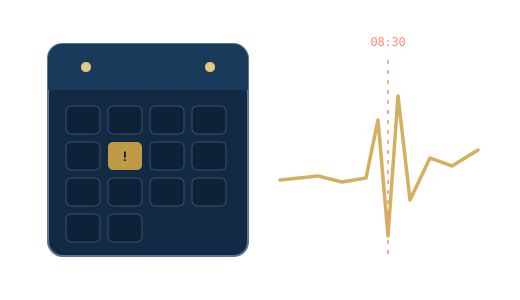
Twice a month, at exactly 16:30 Gulf time, the US Bureau of Labor Statistics or its statistical siblings release a number — and within one second, EUR/USD can travel further than it normally does in a day. Scheduled news is the closest thing markets have to a published earthquake timetable. The question is not whether to care. It is whether you trade the quake, or build for it.
Not all releases are equal
Every economic calendar grades events by expected impact, and the grading is worth taking seriously. In practice, a handful of releases dominate currency volatility:
- Central bank rate decisions — especially the US Federal Reserve, whose press conferences can move every instrument on your watchlist simultaneously.
- US inflation (CPI) — currently the market’s favourite single number, because it drives rate expectations.
- Non-farm payrolls (NFP) — the classic first-Friday event; jobs data as a proxy for the whole US economy.
- PMIs and GDP — slower burns that shape the narrative between the big prints.
For gold and oil traders, add inventory reports and any OPEC+ communication. For index traders, add mega-cap earnings weeks. Your calendar should be filtered to the currencies and assets you actually hold — an unfiltered calendar is noise with timestamps.
The number that matters is the surprise
Markets do not react to data; they react to the gap between data and expectation. Before every release, surveyed economists produce a consensus forecast — and by release time, that consensus is already in the price. Inflation printing at 3.0% is bullish, bearish or nothing depending entirely on whether the market expected 2.8% or 3.2%.
This explains the moves that confuse newcomers: “good” news followed by a falling market usually means the news was good, but less good than priced. Always read releases as actual vs consensus, never as raw numbers.
The market does not move on news. It moves on the difference between the news and what it had already decided to believe.
Three honest ways to handle a release
- Stand aside. The professional default. Flatten or reduce positions before high-impact prints on instruments you hold. Spreads widen and slippage grows around releases — even a correct directional guess can be ruined by fill quality in the first seconds.
- Trade the aftermath. Let the initial spike exhaust itself — often 15 to 60 minutes — then trade the cleaner move that follows, once spreads normalise and the market picks a direction. You sacrifice the first violent leg in exchange for tradable structure.
- Position before, sized for chaos. For experienced traders only: hold a position into the release because your broader thesis anticipates the surprise — but sized so that a full adverse spike through your stop, with slippage, still costs less than your normal per-trade risk.
What is not on this list: reacting at market in the release second. In the first moments after a big print you are competing with algorithms on latency, paying the widest spread of the day, for a price that may gap through any stop you set.
Build the habit
Sunday evening, ten minutes: open the week’s calendar, filter for high-impact events in your instruments, and write the times — converted to Gulf Standard Time — where you plan your trades. Volatility you scheduled for is a plan. Volatility that finds you mid-position, oversized and surprised, is a story you will tell with regret.
Key takeaways
- A few releases drive most currency volatility: rate decisions, CPI, NFP. Filter your calendar to what you hold.
- Markets price the consensus in advance — trade the surprise, not the headline number.
- Standing aside and trading the aftermath are legitimate strategies; reacting in the release second is not.
- Review the week’s calendar every Sunday and plan positions around the schedule, in your own time zone.
This article is educational content, not investment advice. Trading forex and CFDs on margin carries a high risk of loss; figures shown are illustrative. Read our Risk Disclosure before trading.