Walk through the Gold Souk in Deira and you are looking at the oldest risk-management system in the region. Long before spreads and margin calls, families here stored wealth in metal because they trusted it to survive whatever paper did not. That instinct never left — it just moved onto trading screens.
The metal that behaves like a currency
On a trading platform, gold is quoted as XAU/USD — an exchange rate, not a commodity price. That framing is correct. Gold trades like a currency issued by no government: it pays no interest, defaults on nothing, and responds to the same macro forces that move the dollar, just in mirror image.
Three drivers explain most of gold’s big moves:
- Real yields. Gold pays nothing, so when inflation-adjusted US bond yields rise, holding gold has a real cost and the price tends to fall. When real yields fall — or go negative — gold’s zero yield suddenly looks generous.
- The US dollar. Priced in dollars, gold gets cheaper for the rest of the world when the dollar weakens, lifting demand — and vice versa.
- Fear, properly defined. Not every scary headline moves gold. What moves it is doubt about the system itself: banking stress, sanctions risk, debt-ceiling brinkmanship, wars that redraw trade routes.
Why central banks keep buying
Since 2022, central banks — led by emerging-market institutions — have bought gold at the fastest pace in half a century. The motive is not nostalgia. Reserves held in foreign currencies can be frozen; gold in your own vault cannot. For states rethinking their exposure to any single currency system, the metal is neutral infrastructure.
For traders, this matters for one practical reason: persistent official-sector buying puts a slow, price-insensitive bid under the market. It does not prevent corrections — gold fell hard in 2013 and 2022 — but it changes the character of dips.
Gold is not a bet that the world ends. It is a bet that governments will keep solving their problems with printed money — which, historically, is one of the safest bets available.
How Gulf traders actually use it
In this region gold plays three distinct roles, and confusing them is a common mistake:
- The generational store. Physical metal, bought on weddings and Eids, never intended to be traded. Leave it alone — it is doing its job.
- The portfolio hedge. A strategic allocation (commonly 5–10%) that cushions equity drawdowns. Rebalanced yearly, not watched daily.
- The trading instrument. XAU/USD as a CFD — liquid nearly 23 hours a day, responsive to US data, and volatile enough to demand tight risk control.
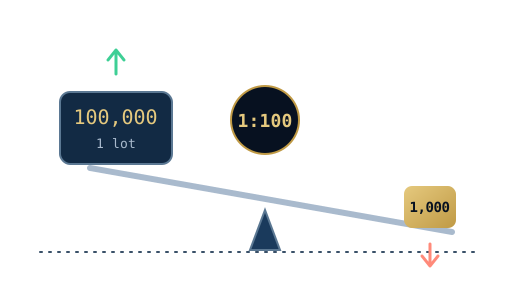
The third role is where leverage lives, and where discipline matters most. Gold can move $30 in the minutes after a US inflation print. Position sizes that feel comfortable in EUR/USD can be reckless in gold — check the instrument’s dollar-per-pip value before you trade it, not after.
A note on timing and sessions
Gold’s liquidity follows the sun. The deepest, most orderly pricing arrives when London and New York overlap — roughly 16:00 to 20:00 Gulf time. The Asian session is quieter and spreads can widen; sharp moves there tend to retrace more often. If your strategy depends on precise entries, trade the overlap.
Key takeaways
- Gold trades like a currency with no issuer — real yields and the US dollar drive most of its price action.
- Central-bank accumulation provides a structural bid, but does not prevent sharp corrections.
- Separate your roles: generational metal, portfolio hedge and trading position obey different rules.
- Respect gold’s volatility around US data; size positions by dollar risk, not habit.
This article is educational content, not investment advice. Trading forex and CFDs on margin carries a high risk of loss; figures shown are illustrative. Read our Risk Disclosure before trading.