Ask ten new traders what leverage is and most will say some version of “it lets you trade with more money than you have.” That is technically true and practically dangerous. Leverage is not extra money. It is a magnifier — of gains, of losses, and above all of mistakes.
What leverage actually is
When you trade forex or CFDs on margin, you never borrow money in the everyday sense. Instead, your broker asks you to post a fraction of a position’s full value as collateral — the margin — and the ratio between the full position and that collateral is your leverage.
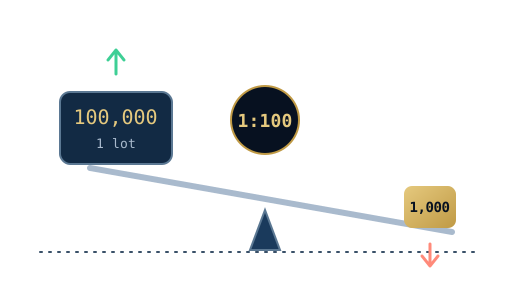
At 1:100 leverage, controlling a standard lot of EUR/USD — €100,000 of notional exposure — requires roughly $1,000 of margin. Your profit and loss, however, are calculated on the full €100,000, not on your $1,000. That single sentence is the whole game. Everything else about margin trading follows from it.
The arithmetic nobody runs
Suppose EUR/USD moves 0.5% against you — an unremarkable day. On an unleveraged position, you are down 0.5%. On the same position at 1:100 with your whole balance committed as margin, that 0.5% market move is a 50% loss of your capital. The market did nothing dramatic; your sizing did.
This is why regulators around the world cap retail leverage, and why the difference between a trader who survives their first year and one who does not is rarely their win rate. It is the size of their positions relative to their account.
Professionals do not ask “how much leverage can I get?” They ask “how much of my account do I lose if this trade hits its stop?” The leverage ratio is an afterthought.
Margin calls and stop-outs
Your platform tracks two numbers continuously: equity (balance plus floating profit or loss) and used margin (the collateral locked by open positions). Their ratio is your margin level.
- Margin call — when equity falls to a warning threshold (commonly 100% of used margin), the broker alerts you to add funds or reduce positions.
- Stop-out — if equity keeps falling (commonly to 50% of used margin), the platform begins force-closing your positions, largest loser first, to protect you from going negative.
A stop-out is not the broker punishing you. It is the seatbelt engaging — but a seatbelt you never want to test. Traders who regularly flirt with margin calls are telling the market their sizing is wrong, and the market always collects on that eventually.
How professionals use leverage
Here is the counterintuitive part: professional traders with access to high leverage rarely use much of it. A common institutional risk framework limits any single trade’s potential loss to 1–2% of capital. Work backwards from that number, through the stop distance, and the resulting position size usually implies effective leverage of 3:1 to 10:1 — even on accounts offering 1:400.
The available leverage ratio is like a car’s top speed. The fact that the dial reads 260 km/h does not mean the highway changed. Use leverage to be capital-efficient — to avoid parking your entire net worth at a broker — not to take positions your account cannot absorb.
A worked example
Say you have a $10,000 account and you are willing to risk 1% ($100) on a EUR/USD trade with a 25-pip stop-loss. Each pip on a mini lot (10,000 units) is worth about $1, so a 25-pip stop costs $25 per mini lot. Your maximum size is therefore four mini lots — $40,000 of notional, or effective leverage of 4:1.
Notice what happened: the risk decision produced the position size, and the position size produced the leverage. At no point did “maximum available leverage” enter the calculation. That ordering — risk first, size second, leverage last — is the entire discipline.
Key takeaways
- Leverage magnifies exposure; it does not create money. P&L is calculated on the full position size.
- Small market moves become large account moves when positions are oversized.
- Margin calls and stop-outs are safety mechanisms — hitting them regularly means your sizing is wrong.
- Decide risk per trade first, derive position size from your stop distance, and let leverage be the by-product.
This article is educational content, not investment advice. Trading forex and CFDs on margin carries a high risk of loss; figures shown are illustrative. Read our Risk Disclosure before trading.