Every trader eventually meets the same uncomfortable truth: over a long enough horizon, your edge decides how much you make, but your risk management decides whether you are still there to collect it. Strategy gets the glory. Risk management pays the bills.
Habit one: risk a fixed fraction, always
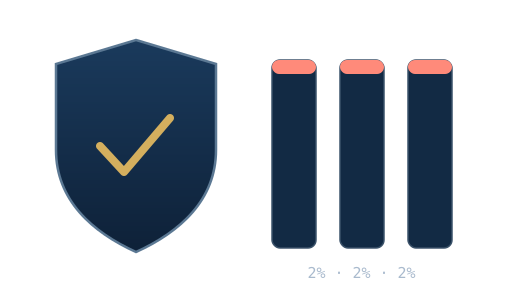
Consistent traders decide — before the week begins, not in the heat of a setup — what one trade is allowed to cost. The convention is 1–2% of account equity. The exact number matters less than its fixedness: the same fraction on the boring trades and the “sure things,” because you cannot know in advance which is which.
The arithmetic behind this habit is unforgiving in a useful way. Lose 10% of your account and you need 11% to recover. Lose 50% and you need 100%. Fixed fractional sizing keeps every individual loss in the shallow end of that curve, where recovery is arithmetic rather than heroics.
Habit two: the stop is set before the entry
A stop-loss placed after you are in a position is not a risk decision; it is a negotiation with your own hope. Consistent traders define the invalidation point first — the price at which the trade idea is simply wrong — and only then calculate whether the distance to that point allows an acceptable position size.
If the honest stop is too far away for the size you want, the answer is a smaller size or no trade. Moving the stop closer to “make the numbers work” just relocates the lie.
Amateurs decide how much they want to make. Professionals decide how much they are willing to lose. The market decides the rest either way.
Habit three: a daily stop for the trader, not just the trade
Losses cluster. A volatile session that stops you out twice is exactly the session in which your judgement is most degraded and revenge-trading feels most reasonable. The habit that breaks this loop is a daily loss limit — commonly two or three times single-trade risk — after which the platform gets closed. Not reviewed, not watched: closed.
This is not an admission of weakness. Trading desks impose daily limits on professionals precisely because everyone’s decision quality decays after consecutive losses. Yours does too.
Habit four: journal the trade before and after
A journal that only records outcomes is a diary. A useful one records the reasoning: why this setup, why this size, what would invalidate it — written before entry — and afterwards, whether you followed the plan, regardless of profit.
Review it weekly and patterns surface with embarrassing speed: the pair you consistently misread, the session where your losses concentrate, the way winners get cut early after two red days. None of that is visible from a P&L number alone.
Habit five: count your real exposure, not your positions
Six open trades are not six independent risks if four of them are long the US dollar in different costumes. EUR/USD, GBP/USD, gold and the Nasdaq all react to the same Federal Reserve surprise. Consistent traders group positions by their true driver — dollar risk, oil risk, risk appetite — and cap the total, not just the per-trade slice.
A quick test before adding any position: “what single headline hurts everything I currently hold?” If one headline can, you have one big trade, not several small ones — size it like one.
Key takeaways
- Risk a fixed 1–2% fraction per trade — losses stay shallow enough that recovery is arithmetic.
- Define the invalidation point before entry; derive position size from it, never the reverse.
- Set a daily loss limit and actually stop — decision quality decays after consecutive losses.
- Journal reasoning before the trade and adherence after it, then review weekly.
- Cap correlated exposure: many positions with one driver are one big trade in disguise.
This article is educational content, not investment advice. Trading forex and CFDs on margin carries a high risk of loss; figures shown are illustrative. Read our Risk Disclosure before trading.