Put a chartist and a macro analyst in front of the same EUR/USD screen and they will see two different markets. One sees a break of a range with rising momentum; the other sees an interest-rate differential that has not moved in a month. The century-old argument about who is right misses the more useful question: what is each lens actually for?
What the technical lens sees
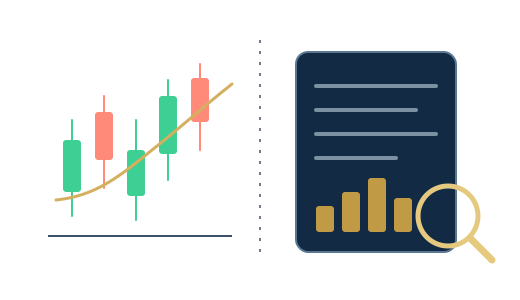
Technical analysis reads price itself — on the theory that everything knowable is already being expressed by what buyers and sellers do. Its raw material is the chart: trends, support and resistance, momentum, volume, and the repeating footprints of crowd behaviour.
Its genuine strengths are practical ones:
- Timing. Fundamentals rarely tell you when to enter. Charts, whatever else they do, give you concrete levels for entries, stops and targets.
- Risk placement. “Wrong below 1.0780” is a testable statement. A fundamental view is rarely falsifiable at any single price.
- Universality. The same toolkit reads gold, indices and currencies without needing to understand any of their economics.
Its blind spot is equally clear: charts describe the crowd, and the crowd changes its mind. A perfect pattern is a probability, not a promise — and it dissolves instantly when a central bank clears its throat.
What the fundamental lens sees
Fundamental analysis asks what a thing should be worth. For currencies, that means interest-rate differentials, inflation, growth, trade balances and the credibility of the institutions behind them. When the European Central Bank holds rates while the Federal Reserve cuts, capital flows respond — and EUR/USD eventually follows the money.
The fundamental lens excels at direction and duration: it explains why some trends persist for quarters, and it warns you when a chart pattern is fighting the macro tide. Its weakness is timing. “The dollar is overvalued” can be true for two years while dollar longs keep paying. Markets, as the old line goes, can stay irrational longer than you can stay solvent.
Fundamentals tell you which way the river flows. Technicals tell you where to put your boat in the water. Traders drown by confusing the two jobs.
How working traders actually combine them
Beneath the tribal debate, most consistent traders converge on some version of the same division of labour:
- Fundamentals set the bias. Read the macro picture — rate paths, inflation trajectory, risk appetite — and decide which side of an instrument you are willing to trade. If the Fed is cutting while others hold, favour dollar weakness; do not fight it intraday because a candlestick asked you to.
- Technicals trigger the trade. Within that bias, let the chart supply the entry, the stop and the target. You get the falsifiability that fundamentals lack, pointed in the direction the fundamentals justify.
- The calendar referees. Scheduled events — covered in our economic calendar guide — are when fundamentals get re-marked. Technical setups straddling a rate decision are borrowing conviction from a coin flip.
Choosing where to start
If you trade short timeframes — minutes to hours — start technical: at that scale, crowd behaviour is most of what exists, and fundamentals change too slowly to matter within a session. If you hold for weeks, start fundamental: the longer the horizon, the more the macro tide dominates any pattern.
And if you are brand new: learn to read a chart first, because it teaches risk placement — but read the macro summaries daily until the bigger story becomes familiar. The traders who last are rarely purists. They are bilingual.
Key takeaways
- Technicals excel at timing and risk placement; fundamentals excel at direction and duration.
- Each lens has a blind spot the other covers — purism is a handicap, not a philosophy.
- A robust workflow: fundamentals set the bias, technicals trigger the trade, the calendar referees.
- Match the lens to the timeframe: shorter horizons lean technical, longer horizons lean fundamental.
This article is educational content, not investment advice. Trading forex and CFDs on margin carries a high risk of loss; figures shown are illustrative. Read our Risk Disclosure before trading.